
Understanding neurodivergent shutdowns
Why shutdowns happen and how to respond with care

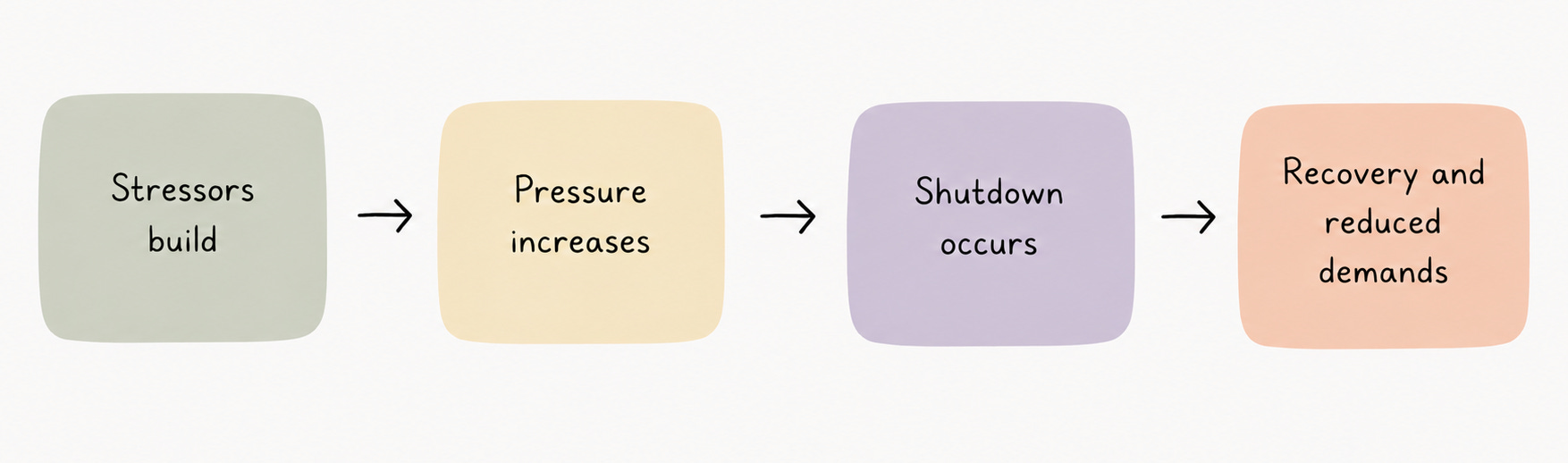
I recently wrote a two-part series on meltdowns; part one is here. Like meltdowns, shutdowns are the result of immense pressure build-up from facing triggers, challenges, and demands that increase stress and drain energy.
A shutdown is an involuntary response to overwhelm. Rather than expressing distress outwardly, a person's brain and body begin to withdraw. They may become unable to speak, think clearly, move, make decisions, or engage with the people and world around them.
Shutdowns can involve significant physical and mental changes. They can be distressing for the person experiencing them, yet they’re often misunderstood by those around them.
While meltdowns are often more visible, shutdowns are just as important to understand. For many neurodivergent people, they are actually more common.
In my research, I’ve heard people describe being laughed at, disciplined, ignored, or assumed to be fine during shutdowns because others didn’t recognise what was happening.
If you experience shutdowns, understanding them can help you communicate your needs more effectively. If you love someone who experiences them, understanding them better can help you offer loving, appropriate support.
The brain
During a shutdown, the brain responds to overwhelm by reducing its ability to engage with the world around it. As stress levels rise, it becomes harder to think clearly, communicate, make decisions, move, and interact with other people. The brain is prioritising survival over higher-level thinking and engagement.
This isn’t a choice or a behavioural strategy. It’s an involuntary nervous system response to intense pressure.
How shutdowns may look
Shutdowns can look very different from person to person. They often involve someone becoming less able to engage with the world around them. This may affect their speech, movement, responsiveness, thinking, or ability to participate in what is happening around them. A shutdown may last less than a minute or continue for much longer.
One parent tells me when their children shutdown they see:
“complete silence, no response to any stimuli, like they are just a husk of a person.”
Another parent described shutdowns for her daughter as:
“Shaking, trembling, unable to speak, stammering. Body language: turning in herself, looking down and away, clenching fists… Can present as catatonic – body stiffens, will not speak or respond, and stares vacantly, becomes non-responsive.”
Have you seen this in your children?
I can remember being at a school event for one of my children some years ago. The children were all sitting but then a teacher put on a song that all the students loved. All at once, the children sprang up, yelling the words and dancing. But my child remained sitting, face and body completely frozen, eyes vacant. I went to the teacher and asked if I could go to my child, but the teacher said they’re clearly fine or they would look upset or come over.
It's a common misunderstanding. Many people assume someone would look visibly distressed if they were struggling. But during a shutdown, a person may appear calm, vacant, or disengaged while experiencing significant overwhelm internally.
How shutdowns may feel
From the outside, shutdowns can look like stillness, silence, or withdrawal. But the internal experience is often far more intense than observers may realise.
A recent study[1] asked autistic adults who experience shutdowns to describe the feeling of shutdowns. They said:
“I freeze like a statue and can’t move by myself. I feel more overwhelmed than can even be described and completely bewildered.”
“Impossible to move. Impossible to think. Impossible to cry. I can’t get up … It’s like the brain and the body will not work.”
Others described how exhausting even the smallest actions become:
“It feels as if it takes as much energy to speak a sentence as it does to sprint a mile”
Others say they can speak, but they can’t think critically:
“[I] have no agency anymore…When I’m ‘shutdown’, if I’m not mute, I’m a yes man. I will agree to any plan, any offer and any request… I’ll agree to it in spite of myself, potentially leading to more issues later.”
Young people describe similar experiences. In a study of neurodivergent youth[2], one participant said:
It kind of feels like my blanket weighs 500 pounds and it’s weighing me down.
In my research, I’ve heard similar reflections from people who experience shutdowns.
A Christian AuDHDer told me,
When I shut down, I just stop. I sit down looking blankly in the distance. I can’t process any thoughts, I can’t talk or move. I feel empty, disconnected. I lose all appetite and have no motivation to break out of it

Causes of shutdowns
Shutdowns can be triggered by a single overwhelming event or by pressure gradually building over days or weeks. Often, there isn’t one obvious cause. Instead, a series of stressors slowly drains a person’s capacity to cope until their nervous system reaches its limit[3].
The same things that contribute to overwhelm and increase stress can contribute to shutdowns. These might include:
Sensory overwhelm, such as environments that are noisy, bright, crowded, or otherwise exhausting. Ongoing sensory stress can heighten anxiety and deplete energy.[4] See my articles on the senses here.
Social stressors, such as navigating conversations, relationships, expectations, perceived rejection, or unfamiliar social situations. See my articles on rejection here and exhaustion here.
Cognitive overload, such as juggling lots of tasks at once, breaking a big task down, solving a problem or coping with a demand, for example.
Masking for a long period of time. See my article on masking here.
Environmental changes, moving between places or adjusting to changes in routine or surroundings, even when expected.
And many other stressors, which vary from person to person.
Shutdowns are not a sign of weakness, poor resilience, laziness, or inattention. They are the result of immense pressure. During a shutdown, access to higher-level thinking and decision-making is reduced, making it difficult to reason, communicate, or respond[5]. This isn't the time to expect action or demand answers.
Whether a shutdown lasts seconds or several hours, the person will benefit from understanding, reduced demands, and compassionate support.

Effective, loving support
A shutdown can be difficult for the person experiencing it and also for those who love and care for them. As Christians, we have the opportunity to respond with understanding, patience, and sacrificial love.
In Philippians 2:3–4, we’re reminded:
In humility value others above yourselves, not looking to your own interests but each of you to the interests of the others.
The chapter goes on to describe Jesus’ humility and obedience as he went to the cross, and we’re told, “In your relationships with one another, have the same mindset as Christ Jesus.”
When we take the time to understand and support those we love, Jesus is our model: we work to meet their needs above our own, loving as Christ loves us. With Jesus as our model, there may be times we do things differently to others, times when we put our needs aside for our loved one. We may give space when we’d rather have an answer, reduce demands even when it creates extra work for us, or adjust the environment instead of expecting someone to simply push through.
We still want those we love to grow in responsibility and service, but we may need to adjust our expectations about when and how that growth happens. Perhaps they need a break before tackling a task, someone to do it alongside them, or perhaps they need to leave it altogether today. We might adjust the sensory environment, encourage time for regulation, or help them identify what is contributing to the overwhelm.
Understanding shutdowns doesn't mean lowering expectations forever. It means responding wisely to what a person is capable of in that moment. Ignoring difficulties rarely builds resilience. Instead, it can teach someone to bottle up their struggles, avoid challenges, or push themselves beyond their limits until they eventually collapse. Understanding and responding well allows us to help them grow as they learn to recognise what is difficult and develop healthy ways to navigate it.
As we seek the good of others ahead of our own convenience, we reflect something of Christ’s humility and love.
It’s important to support the person well before, during, and after shutdowns. Even if the shutdowns are brief, they might indicate something larger going on inside.
Supporting someone during a shutdown
Stay calm.
Reduce demands.
Use simple reassuring statements, such as “take your time.”
Follow the person's preferences around touch and interaction. Some people appreciate a reassuring hug, while others need space.
Give processing time. Don't expect immediate answers or decisions.
Supporting recovery after a shutdown
Allow recovery time.
Offer a low-sensory environment, see my article on regulating here.
Don’t expect an immediate return to normal functioning.
When they're ready, gently explore what may have contributed to the shutdown.
Reducing future shutdowns
Identify recurring stressors.
Reduce unnecessary demands, where possible.
Build supports around known challenges.
Encourage the person to recognise early signs of overwhelm and communicate their needs.
Through all stages, we can pray to our Father for wisdom and patience. We can pray that he might reduce the pressure our loved ones are facing. And we have the joy of encouraging them to likewise turn to him in prayer.
Shutdowns aren't a sign that someone has failed. They're a sign that the pressure has become too great. As we seek to understand the person, reduce unnecessary pressure, and support recovery, we communicate that they’re seen, loved, and not alone. We have the privilege of loving with patient, generous love, following our Lord Jesus. Over time, this kind of care can build trust, reduce fear, and help people navigate overwhelm with greater confidence.
FOOTNOTES
[1] Paris, K., Lodestone, A. “Zeph,” Houser, M., & Lewis, L. F. (2025). “Shutdowns Are Like You’re Stuck on the Blue Screen of Death”: A Metaphor Analysis of Autistic Shutdowns. Autism in Adulthood. https://doi.org/10.1089/aut.2024.0193
[2] Phung, J., Penner, M., Pirlot, C., & Welch, C. (2021). What I Wish You Knew: Insights on Burnout, Inertia, Meltdown, and Shutdown From Autistic Youth. Frontiers in Psychology, 12, Article 741421. https://doi.org/10.3389/fpsyg.2021.741421
[3] Lewis, L. F., & Stevens, K. (2023). The lived experience of meltdowns for autistic adults. Autism : The International Journal of Research and Practice, 27(6), 1817–1825.
[4] T Attwood, The Impact of Anxiety on Daily Life, https://www.attwoodandgarnettevents.com/blogs/news/autism-the-impact-of-anxiety-on-daily-life
[5] Dundon, R. (2023). A Therapist’s Guide to Neurodiversity Affirming Practice with Children and Young People (1st ed.). Jessica Kingsley Publishers. P 84-85.

So outstanding, Kate. I'll be sharing with my people. Thank you for this helpful information.
Thank you for sharing this! I’m a teacher, and had difficulty recognizing this a couple years ago. Once I understood what was happening, the student flourished.